miércoles, 18 de junio de 2014

USEFUL SCIENCE INFORMATION-

As we are having our final exam really soon, here  are some tips to study:
I. Vocabulary words. You need to know the meanings of the following words that you  have already copied in your notebooks:
a. matter
b. element
c. periodic table
d. mass
e. density
f. volume
g. atom
h. property
i. buoyancy
j. pressure
k. mixture
l. solution
m. physical property and physical change
n. states of matter
o. chemical property and chemical change

2. Some other words that you need to know:
a. position: the location of an object. Example: Look at the helicopter's position.


b. motion: when an object keeps changing position. Example: Look at the picture. The man is in motion, it keeps changing position.


c. relative position: the position of one object compared with the position of another object. Look at the picture. What is the position of the Moon compared with the position of the Earth?


d. speed: how fast an object changes its position. Look at the picture. How fast do these cars move? There are two types of speed: constant, when it doesn't change and variable, when the speed changes, they can move faster or slower.


 We measure speed using a speedometer: It tells us the number of kilometers a car runs in one hour.


e. potential energy. It is stored energy that can be used to do work. for example, a battery, when you place it in a toy, it can make the toy move. Look at the picture. The ball at the top of the slope doesn't move, but if it is pushed by a force, it can start moving, rolling down the slope.


When the machine is holding the ball, it has potential energy. When it lets the ball fall, it becomes kinetic energy, as it is falling down.


f. kinetic energy. It is the energy of motion. Look at the picture. As you fall down the roller coaster, kinetic energy is responsible for movement.


You may want to try the roller coaster game which lets you try different combinations to create your own roller coaster. Read the instructions carefully so you can play.

http://rollercoastergamesonline.com/roller-coaster-games/digital-labs-coaster-creator

You need to have Java for this one:
http://www.funderstanding.com/educators/coaster/


The following page contains interesting facts about motion, force and velocity:
http://idahoptv.org/dialogue4kids/season12/force_and_motion/facts.cfm

This page also has games and activities. Try the ones about "sound".

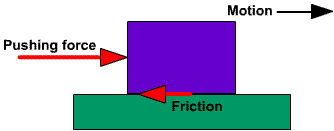
g. friction. It is a contact force that opposes the motion of an object. Friction make objects slow down.


h. vibration. a very quick back-and-forth movement. Vibrations may produce sound. Wind instruments make sounds when air inside them vibrates.


i. compression wave. They are sound waves and look like this:


j. simple machines. Machines help make work easier.  For example:
An inclined plane connects a lower level to a higher level:


A lever is used to lift and move things.


A wedge split helps cut, or connect things.


A pulley changes the direction of how something moves, for example, sailors use them to raise the sail.


II. Check the phases of the moon. What are the waxing phases? what are the waning phases?
Don't forget the names of the planets! 

Good luck!

miércoles, 4 de junio de 2014

GLOBAL WARMING - ENVIRONMENT DAY'S ACTIVITIES

Today we celebrate the Environment Day. This reminds us how important our planet is, it is not only our home, but the home of millions of living beings. We are responsible for understanding how our actions contribute to damaging our environment and take the necessary actions to avoid them.

Education is very important, we need to learn about environmental issues. To celebrate this important date we are doing a special activity, follow the steps very carefully.

1. Watch the video.


2. Read the article and answer questions on your worksheet.


The Greenhouse Effect

The greenhouse effect is not a new phenomenon.It is a natural process that helps to heat the earth's surface to the temperatures necessary to support life.


Naturally occurring gases such as carbon dioxide, methane, nitrous oxide and halocarbons and also water vapour in our atmosphere act like a blanket around the Earth. They allow the sun's rays to warm the Earth's surface, and also prevent much of the heat escaping, so that the Earth’s temperature is maintained at reasonable levels.

The gases which trap the heat from the sun are called greenhouse gases.


Certain human activities add to the levels of most of these naturally occurring gases: 
  •  When solid waste, fossil fuels (oil, natural gas, and coal), and wood and wood products are burned.
  • Rice production, the decomposition of organic wastes in municipal solid waste landfills, and the raising of livestock. Methane also is emitted during the production and transport of coal, natural gas, and oil.
  • Agricultural and industrial activities, as well as during combustion of solid waste and fossil fuels.

 Our protective blanket is now trapping too much heat and steadily increasing

the Earth’s average or mean temperature. Even a very small rise in the Earth’s mean temperature will have quite dramatic negative impacts on ourenvironment. These impacts are predicted to include melting of polar ice caps, rising sea levels, increasing

intensity and frequency of storms, and changes to weather patterns, including prolonged droughts, that will reduce agricultural productivity as well as our

recreational and tourism activities.


Scientists believe that if the Earth’s mean temperature increases more than 2°C, irreversible damage could occur to ecosystems throughout Australia including possible destruction of Ningaloo Reef and the Great Barrier Reef. Without the protection of the greenhouse effect the Earth’s average temperature would be a rather chilly -18° Celsius and we would find it rather difficult to survive.


The Earth is warming at a faster rate than any time in the last 10,000 years – the 1990s was the warmest decade in the last millennium.  

3. Play some games at:


miércoles, 14 de mayo de 2014

The Digestive System

We will start learning about the different systems that interact to keep us moving and in action. Our body systems work very hard, all the time, and we don't have to worry about controlling them, they are controlled by our brain, and they are really efficient.

The first body system we will learn about, is the digestive system. All that we eat enters our body through the mouth, but it moves through different parts where the food is processed to pass the nutrients to our blood. Our blood carries all nutrients to every single cell in our body. 

We know we have to eat a balanced diet every day. We have learned about the "eat well plate". Now we will learn about what happens with the food that we eat, where it goes, how it makes us strong...

Click on this link, explore the page,read the article, do the quiz, check how much you know about the digestive system ..

http://kidshealth.org/kid/htbw/DSmovie.html

You may travel inside the digestive system and see how different types of food travel through it until waste products are sent out of our organism. You need to read and follow directions...

 http://interactivehuman.blogspot.mx/2008/05/digestion-interactive-game-for-kids.html

You have to do the quiz in this link to check how much you have learned about the digestive system!

http://easyscienceforkids.com/fun-digestive-system-quiz-free-interactive-science-quiz-for-kids/

Have fun and learn!


lunes, 12 de mayo de 2014

Science - The Eat Well Plate

The Eat Well Plate is a guide to help us decide the kind of foods we should eat to be healthy and what are the right amounts to keep a balanced weight. The Eat Well Plate includes foods from different groups. Try the games and activities in the following link to learn about this. You need to select a language, click the option to your right (Wales).

http://tna.europarchive.org/20100929190231/http://www.eatwell.gov.uk/info/games/#elem226302

Also watch this video which gives good information about the contents of an eat well plate:

http://www.youtube.com/watch?v=J9UVDzkBhkI


domingo, 6 de abril de 2014

Science Key Words Quiz

Last week we had a Science vocabular quiz. Here are the definitions given in the quiz so you can check your answers. Remember your Science test is on Tuesday, April 8th. and you need to know the meaning of all the key words. You also need to study lessons 1, 2, and 3. It is all about living things interactions.

Watch this video to review some important topics:


Now, here are the word definitions, check the answers with your quiz:

1. A consumer that eats only animals is a...C _ _ _ _ _ _ _ E
2. An organism that makes its own food is called a..P _ _ _ _ _ _ R
3. A consumer that hunts for food is a....P_ _ _ _ _ _ R
4. A living thing that needs to find its food..C _ _ _ _ _ _ R
5. A consumer that eats only plants..H _ _ _ _ _ _ _ E
6. An animal that is hunted by other animals...P _ _ _
7. A consumer that eats plants and animals...O _ _ _ _ _ _ E
8. When two or more living things need the same resource: C _ _ _ _ _ _ _ _ _ N
9. An interaction where both organisms get a benefit: M_ _ _ _ _ _ _ M
10. A living thing that breaks out dead animals or feeds on them: D _ _ _ _ _ _ _ _ R
11. A type of interaction where one organism benefits from another by hurting or harming it...P _ _ _ _ _ _ _ _ M
12. What passes from one organism to another in a food chain..E _ _ _ _ Y
13. Many food chains together: F _ _ _  W _ _


We are almost done for this period, make your best effort in your Exams, you are very smart and you can do it!
Good luck! 
 

lunes, 24 de marzo de 2014

Science Quiz Questions

We had a quiz on Lesson 1 of Chapter 4 which talks about interaction among animals and between plants and animals. Key word to this topic are: producer, consumer, herbivore, carnivore, omnivore, predator, prey, decomposer, mutualism, comensalism, parasitism.  You need to know and understand the meaning of these words.

Here are the questions of the quiz so you can check your mistakes:

Word Bank:

A.prey      B. producer     C. interact     D. decomposer

E.   consumer       F. predator
Use the words in the box to complete the sentences
All living things need food. Plants and animals 1.______, or  work together, with the environment to get what they need. A plant is a 2._________ because it makes, or produces, its own food. An animal that eats, or consumes, other living things as food is a 3.________. Some animals hunt other animals for food. When a snake attacks a mole, the snake is the 4._______ and the mole is the 5.____. A living thing that feeds on dead, or once-living, things is called a 6._______. It helps clean the environment.

Write the letter of the best choice:

7.Which is NOT a consumer?

A. snake   B. chicken   C. jack rabbit  D. orange tree

8.Which is a decomposer?

A. mushroom    B. clover    C. shark   D. turtle

9.Zebras defend themselves by
A. staying in a group      B. spraying their predators 
C.  stomping their feet   D. running away very fast

10.A lion is ____ because it hunts and kills animals for food.
A. decomposer    B. prey     C. a predator     D. a producer
            True or False
1.Interaction with each other help animals survive._____

2.When animals live in groups they can’t help each other.______

3.Different kinds of living things interact with each other in different ways.

4.Some small fish help bigger fish by eating organims that live on them. _______

5.Living in groups help prairie dogs survive.______
Please check and correct your mistakes. 
You can watch again the video we watched in class:
 You can also watch this one:


miércoles, 12 de marzo de 2014

St. Patrick's Day

As a special activity for St. Patrick's Day, you will have to do several activities:

1. Read. Following is some information about this important holiday in Ireland. Read the information and answer the questions:
 
St. Patrick's Day is celebrated in Ireland. Every year on March 17, the Irish and the Irish-at-heart across the globe observe St. Patrick’s Day. What began as a religious feast day for the patron saint of Ireland has become an international festival celebrating Irish culture with parades, dancing, special foods and a whole lot of green.

Check the following link to watch videos about this important Irish celebration:

 http://www.history.com/topics/st-patricks-day

http://www.history.com/topics/st-patricks-day
 Have you ever heard about leperchauns? Read this funny poem:

"A leprechaun is small and green
He hides where he cannot be seen.
But if you catch one on this day,
He must give his gold away."

LEGEND OF THE LEPRECHAUNS (from: http://www.examiner.com/article/kid-s-craft-st-patrick-s-day-leprechaun-treasure-box)

"Full of magic and trickery, the leprechauns remain in their hidden world until the night before St. Patrick's Day. On that one night of the year they appear throughout the world to dance and sing and frolic.

Disguising themselves as leaves and grass, and sounding like the wind and the crickets, they come and go unnoticed.


However, it is said that if a decorated treasure box is left empty under the moon, the leprechauns must fill the box with gold or jewels or gifts. But then they will hide the filled box in the most unlikely of places.


If the box is found on St. Patrick's Day, the treasure remains in our world. If not, the leprechauns may retrieve what is rightfully theirs. And though the leprechauns are very clever, it is not impossible to find the treasure because, unknowingly, leprechauns often leave a trail of greenery behind them."


http://www.kidzworld.com/article/7682-all-about-the-st-patricks-day-leprechaun

Take a St. Patrick's Day quiz at:

http://www.marks-english-school.com/games/mes-patricks_01.htm

How many new words did you learn?

Remember that St. Patrick's  real name is believed to be Maewyn Succat and he took on the name Patrick upon becoming a priest. He was born in Britain and it is believed that his parents were romans living in Britain in charge of the colonies.

When he was 16, he was kidnapped by pirates and sold into slavery in Ireland to herd and tend sheep on Slemish mountain. Learn more about Ireland by clicking on the link below:

http://www.ducksters.com/geography/country.php?country=Ireland

Answer the following questions:

In which continent is Ireland?

What is the size of Ireland?

Describe Ireland's climate.

What is the type of government of Ireland?

What language do people speak?

What is their National Holiday?

What is their National Symbol?

What is their religion?

What is the Nationality of the people from Ireland?

Explore the map of Europe and find Ireland and Britain (England) in it:

http://www.yourchildlearns.com/europe_map.htm

And play with the Europe map puzzle:

http://www.yourchildlearns.com/mappuzzle/europe-puzzle.html 

Good luck!
Don't forget to find the gold pot!