martes, 7 de febrero de 2012

SCIENCE - Lesson 2 - How does the energy flow in ecosystems?

A Food Web
An ecosystem has many food chains. The same food source can be part of more than one food chain. This means that one food chain can overlap another food chain.  For example, coyotes and mountain lions are both carnivores. They both hunt prey like the collared peccary. When food chains overlap, there is a food web.

Make a model of a food web that includes humans. Check these links in computer lab.

http://www.sciencebob.com/questions/q-food_chain_web.php

You can click the link on this page to make a food web:


Try some games and activities at:

http://www.sciencekids.co.nz/gamesactivities/foodchains.html

REMINDER - SCIENCE BOOK LINK

Don't forget you can access the Science book online. To find the link go to "Archivos de Blog" on the right side of the page, then click on "2011", click on "November" and there find the post about "Science Book Online". Just remember that you need an internet connection to get into the page.

Good luck!

ROCK FORMATION, GEOLOGIC TIME SCALE, FOSSIL FORMATION AND ROCK CYCLE

Sedimentary Rock Formation
In this activity, you will watch a video. Then work with your pair and open a Word document to write a paragraph about what you learned from the video. It is about sedimentary rocks formation.

http://www.youtube.com/watch?v=mQGMgR_5jvc

Geologic Time Scale
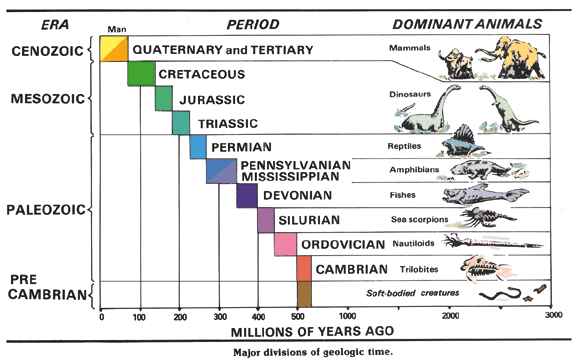
 A geologic time scale divides Earth’s history into four time periods. The earliest period is at the bottom. Newer periods are at the top. The scale’s order is like layers of sedimentary rock. The layers with the oldest fossils are at the bottom. Newer layers of rock form on top. The oldest period, dated more than 2,500 million years ago is the Pre-Cambrian period, the Paleozoic period dates back 570 -290 million years ago. Then the Mesozoic period which took place 248 - 138 million years ago. During the mesozoic period the dinosaurs appeared on the planet.  Finally, the Cenozoic period took from 63 to 2 million years ago. At the beginning of this period dinosaurs disappeared and during the last part, the modern humans were born.  Visit the following National Geographic page where you will find a Prehistoric Time line, pictures and interesting information is found:
 http://science.nationalgeographic.com/science/prehistoric-world/prehistoric-time-line/


On your Word document, write three important facts you find about each period. Now, watch a song video about Geological periods:

http://www.youtube.com/watch?v=SY3MZ_wNFW8

Fossil Formation

Visit the following page with interesting information about how fossils form. In your Word document list the steps for fossil formation:


Watch the following video that tells about fossils and fossil formation:

In your word document, list 10 important things you learnt from watching this video.

Rock Cycle
 Old rocks are always changing into new rocks. This process is called the rock cycle.
Heat, pressure, weathering, and erosion are some forces of this cycle. Not all rocks
complete the cycle. Some rocks may only go through part of the cycle.
Watch these videos to learn more about this process:


You may visit the following web page with more information about the rock cycle:


At the following page, there is an interactive diagram of the cycle with animation. Go through it, then try to complete the cycle yourself at:


Finally, watch this video and take a look at an amazing place where giant crystals formed:

I hope you enjoy your tour through the world of rocks and minerals!


ROCKS AND MINERALS

We have learned that rocks are made of minerals and that scientists test the rock's physical properties like color, luster, hardness and streak to identify the minerals in them. We also learned that there are three different types of rocks according to the way in which they form.  Watch the following video about different types of rock in U.K. (England), then answer some questions using the information in the video.

http://www.youtube.com/watch?v=OJ-Vr_9t5Sg&feature=related

Questions:

1. What are the three types of rocks that you can find in the U.K.?

2. How does igneous rock form?

3. What type of rock is “granite”? How does it form?

4.  What are sediments? What do they form?

5.  What is limestone made of?

6. What changes igneous or sedimentary rocks into metamorphic rocks?

7. What type of rock results after limestone gets heat and pressure?

8.  How is marble used in the U.K.?

9. What type of rock is marble?


Igneous Rocks: Pumice


Obsidian

Metamorphic Rocks:
Gneiss 

Marble

Metamorphic Rock formations

lunes, 23 de enero de 2012

ECOSYSTEMS - ADDITIONAL RESOURCES

Hello 4th. graders,

Here are some useful links for you to check. Don't forget the following are important vocabulary words:

Ecology – The study of the interaction between living and non-living things.
Ecosystem:  all the living and nonliving things in an environment and the many ways they interact
Population:  all the members of one species that live within an area of an ecosystem.
Community:  different populations that interact with each other in the same area.
Niche: the specific role an organism has in its habitat.
Organism: a living thing.


Herbivores:  consumers that get energy by eating only plants
Carnivores:  consumers that eat only animals
Omnivores:  consumers that eat both plants and animals
Decomposers:  organisms that eat the waste and remains of dead plants and animals


Watch the following video. What important ideas can you find?

http://www.youtube.com/watch?v=WuejxJttBqo&feature=related

Following are the objectives of the Science Program Lessons for the 3rd. period, so you should be able to answer or explain these topics:

Lesson 1 Objectives:
•    Explain what a system is. Give an example.
•    Describe the basic characteristics of an ecosystem.

Lesson 2 Objectives:
•    Explain/draw how most living things use energy from the Sun to live and grow.
•    Identify-Represent the relationship among organisms in aquatic and terrestrial
food chains (for example, the role of producers, consumers, and decomposers.
•    Explain; give examples of patterns of interdependence in ecological systems.


I recommend you read the following article:
http://www.nasa.gov/vision/earth/environment/iceberg_C-19.html

Also, you can try this link with games on food chains:
http://www.sheppardsoftware.com/content/animals/kidscorner/games/foodchaingame.htm


 The following video tells about the transfer of energy, so you understand better this process:
http://www.youtube.com/watch?v=8T2nEMzk6_E

Lesson 3 Objectives:
•    Explain, represent, and find examples of the relationship among organisms in aquatic and terrestrial food chains (for example, the role of producers, consumers, and decomposers).
•    Identify and explain the need for nutrients and minerals for living organisms.
•    Match, identify, find examples of patterns of interdependency in ecological systems.


martes, 17 de enero de 2012

Ecosystems

We are learning about ecosystems and here is some interesting information to complete your investigation project at home. Here are some web pages that you can check for information on ecosystems and the different biomes: grassland, deciduous forest, tundra, marine (ocean) etc.:


The following page has basic information about different types of ecosystem as well as some games:

http://www.kidsgeo.com/geography-for-kids/0164-ecosystems.php

This link will take you to a video we watched in class about what an ecosystem is.

http://www.youtube.com/watch?v=EdKhQVHc3Ao

In this page you will find links to videos with a good description of each individual biome.

http://www.neok12.com/Ecosystems.htm

Information about the different biomes (ecosystems) of the world. You will find interesting facts about the location, animal and plant populations, weather, and other characteristics of each biome.

http://www.factmonster.com/ipka/A0769052.html

http://kids.nceas.ucsb.edu/biomes/index.html

Watch this movie and pay attention to the information given about the main six biomes on Earth. At the end there are some questions, I am sure you will be able to answer them correctly!

http://www.kidsknowit.com/interactive-educational-movies/free-online-movies.php?movie=biomes

 Look at the pictures, can you identify what type of ecosystem is each one?


Good luck!

martes, 6 de diciembre de 2011

Flowers and Plant Reproduction

We have talked about another organ of plants: the flower, which is the reproductive organ of the plant.

The following video shows the flower parts:


On your word document tell what are the parts of a flower and what is their function.